Solutions
The platform
coming soonAmmonixCode
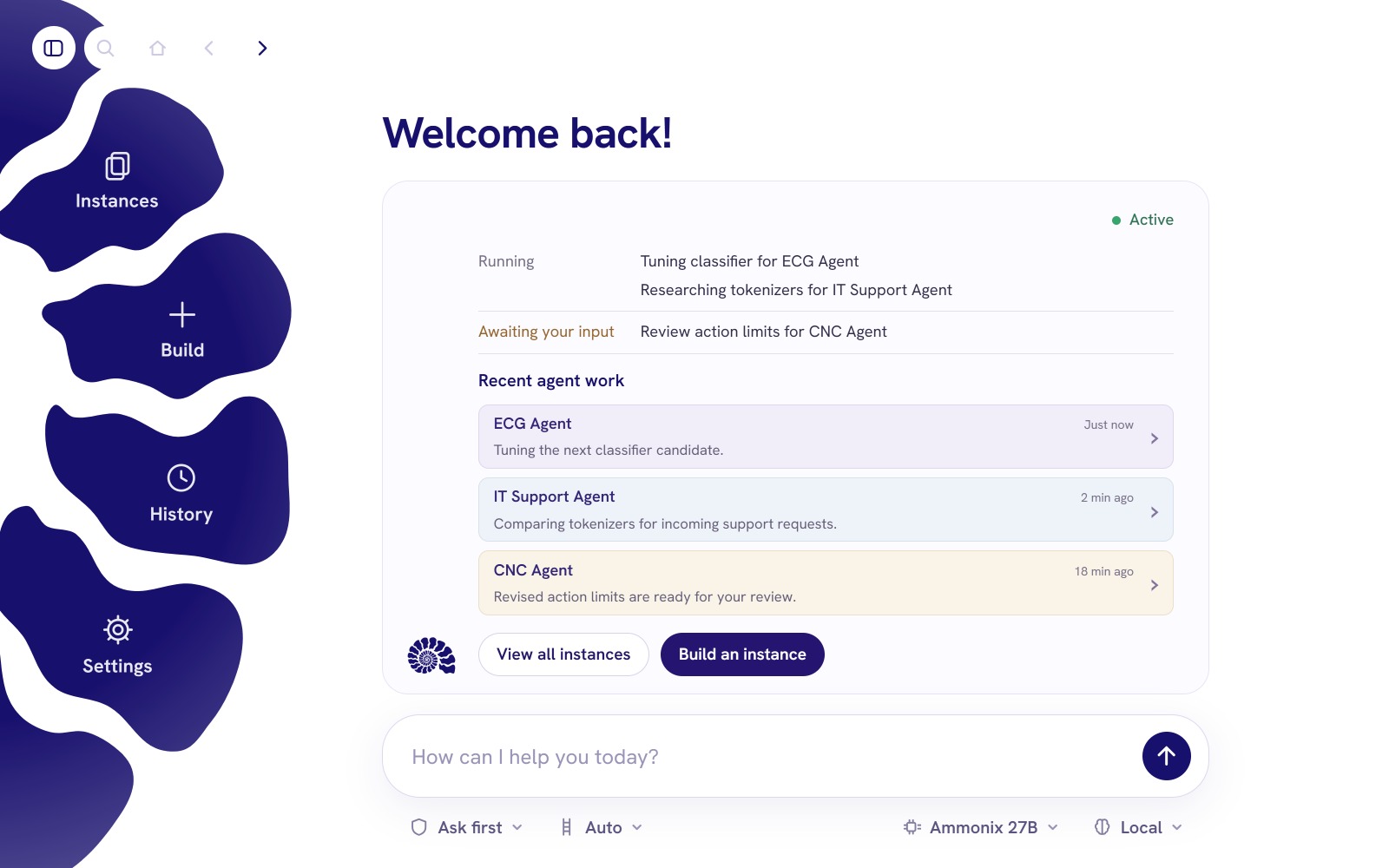
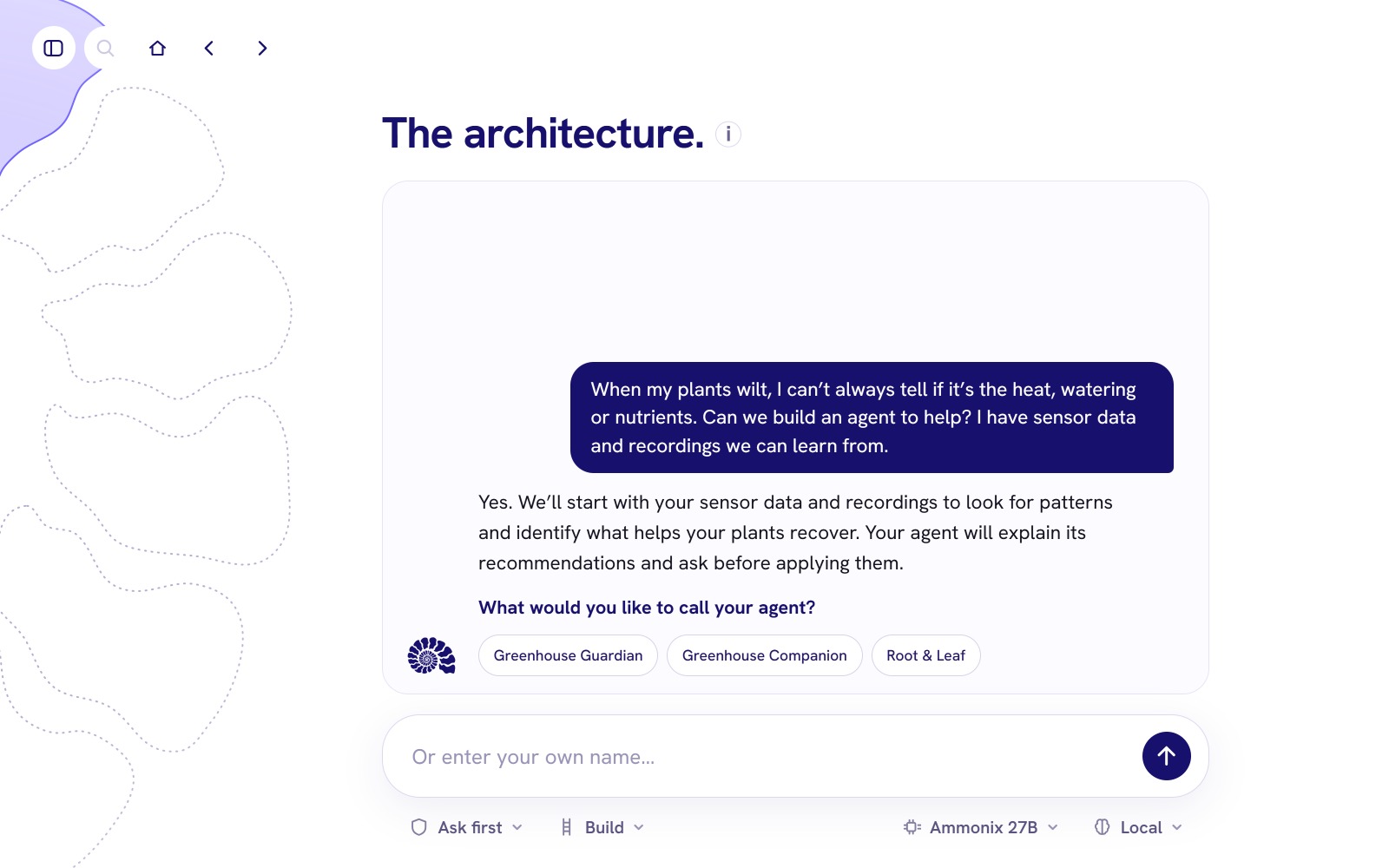
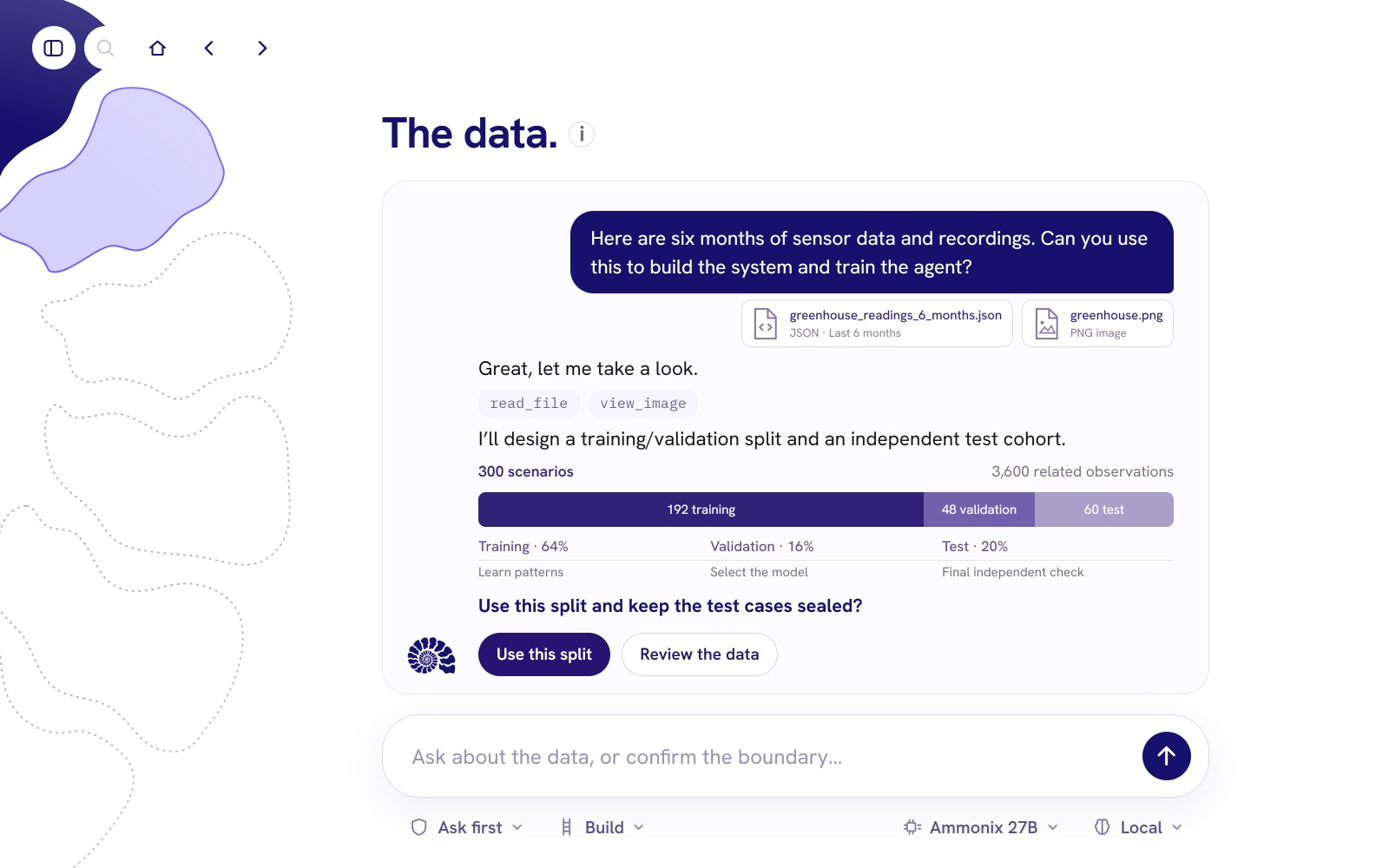
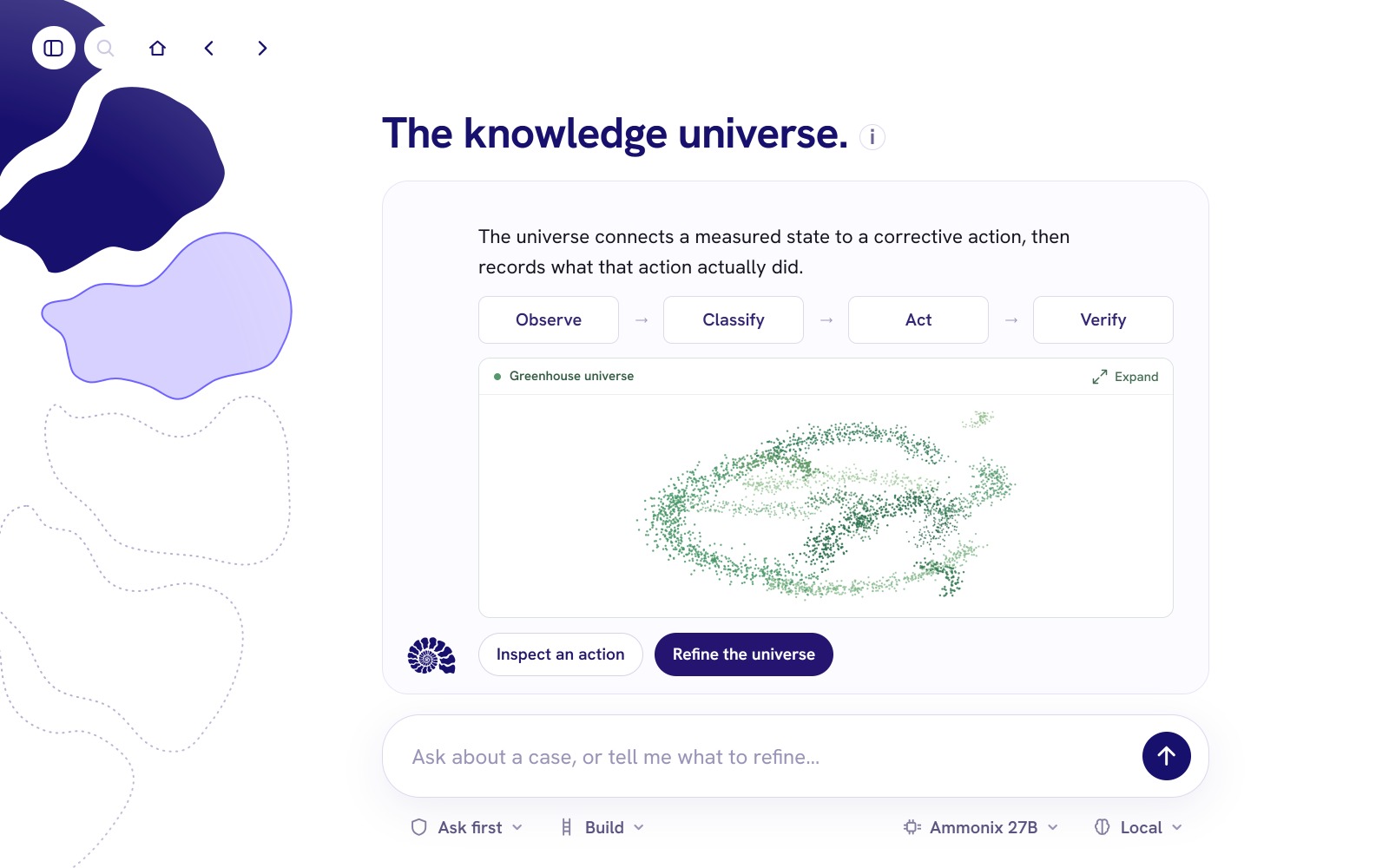
Our architecture-native coding agent, purpose-built to create systems based on the Ammonix architecture. A physician, engineer, scientist or other domain expert provides the knowledge and defines what is correct; AmmonixCode guides the creation of the knowledge universe, the training data, the evaluation, the specialist model, and the user interface.
Use cases
Reference Implementations
In benchmarked evaluation across these domains, Ammonix specialist agents demonstrate higher task-specific accuracy, no hallucinations, and vastly reduced compute footprints compared to general-purpose frontier models. In our most recent registered comparison, on 900 denied claims, the Ammonix claims agent collected 7.9% more than GPT-6 doing the whole job on its own, and it never sent a token to GPT-6. Most run as live demos you can try yourself; the visual inspection agent is shown in a short film.
Computer vision
Fast visual inspection
Airport security, but for animals.
A specialist agent that inspects an image and decides in a few hundred milliseconds. On a held-out benchmark of 35 animal species it reaches 95.7% top-1 accuracy at about 360 milliseconds per image, against 91.4% for GPT-6 at maximum reasoning, which takes roughly 28 seconds per image. Known cases are settled by the fast decision model; only genuine uncertainty is escalated to the frozen language model.
Fast System-One decision models are where the field is heading, Typesafe AI’s Jev among them, but those read structured inputs, not pictures. The Ammonix decision model works from the image itself.
An Ammonix agent about Ammonix
Ask Ammonix
The architecture, running on itself.
Ask Ammonix is itself an Ammonix system, built with the same architecture it describes. It answers questions about how Ammonix works, its evidence, and its limits, using the same decision layer as the domain agents: it draws only on authored, source-linked passages, ranks its options against recorded cases, and says when it does not know. It runs entirely on your own machine against a frozen local Qwen model, on a GPU as small as 8 GB.
▸ How does an Ammonix agent avoid hallucinating?
It answers only from authored, source-linked passages, ranks its options against recorded cases, and says when the evidence is not there. [Foundation §2]
Healthcare revenue-cycle and claims workflow automation
Administration
An agent that prepares healthcare claims and learns from how payers actually decide them. Every answer a payer gives, paid or held, enters its memory and sharpens the next submission, with dollars collected as the score that matters. Every submission it writes can be traced back to the rules and past examples behind it, so a biller can defend any line it produced.
Waste-to-energy control room decision support
Industrial Operations
An agent that supports control-room operators in real time. It watches the plant's signals, retrieves the most similar past situations, and recommends the next move based on how those situations actually ended. Hard safety rules filter every option before anything is ranked, and the operator always makes the final call.
Launch control-room decision support on simulated telemetry
Aerospace
An agent that supports a launch control room from the countdown to booster separation. It reads the telemetry every half second, calls a hold, an abort, or a flight warning when something goes wrong, and backs every call with a clear-text rule and a measured value. It was built and tested on 3,000 simulated launches.
Developed with Fred Canedi, former Senior Project Manager at APCO Technologies, Switzerland.
WaveMedix ECG interpretation and advanced clinical diagnostics
Medical
An agent that reads 12-lead ECGs and explains every finding with the evidence behind it. It measures the features cardiologists already use, places each recording next to the most similar labeled recordings, and checks every call against the trace. When a recording is unclear, it says so instead of guessing, and the physician always keeps the final word. It is a research demonstration, not a medical device.
Application without training
Zero-Shot Transfer
New categories can be defined at inference, by their written descriptions alone, with no retraining. Given a customer message and a set of queue definitions it has never seen, the model reads the descriptions rather than the label names and routes the message correctly, running locally and matching a hosted model and a classic entailment baseline on the same held-out example.
The option names are internal queue codes. The descriptions determine the answer.
Reference answer: B → Q-17
Reads question and descriptions
Descriptions as entailment hypotheses
Local Model, zero shot, pretrained on Multiple Choice answering
First two results from @engineerprompt
The architecture behind these agents is in our Foundation paper.